Circle Way

wp-1465600126678.jpg

Years ago, sometime in the 1990s, I had the privilege to attend the Women’s Dream Quest at Grace Cathedral. It was during this time of much strife and uncertainty that I discovered the labyrinth in this cavernous gothic cathedral. Not knowing what to expect I entered this sacred space nervous and scared but hopeful of finding a sense of spiritual peace. Sleeping bags, pillows and overnight bags lined up against one wall, eighty women gathered around the labyrinth for the opening ceremony.

I took my place in the circle, skepticism growing as we began with chants, songs and dance. Not being gifted with a pleasant singing voice or rhythm to dance I followed in awkward evolution hoping no one would notice I wasn’t verbalizing the words. When the time came to draw cards for smaller group assignments, I was relieved and yet worried knowing I would have to participate. I was assigned to the turtle group. My first thought was at least I can stay hidden within the shell.

We tossed the talking ball back and forth as each woman volunteered to reveal her purpose for being there. I waited to be last whereupon I blurted out, “I just want to sleep overnight in the cathedral.” It wasn’t exactly the truth but I wasn’t willing to share with these people I had met only a few minutes before. I’d have to sleep on it. That was okay.

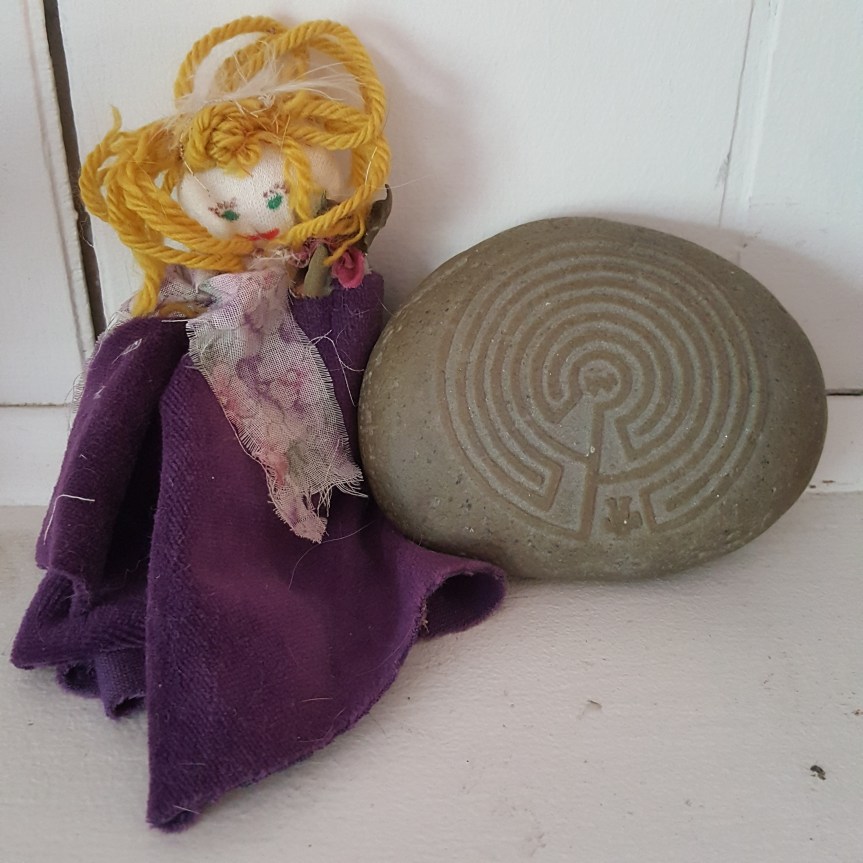
After changing into our night clothes and having a light snack, we returned to the cathedral for the nighttime activities – pretty much whatever you chose to do – some art projects, meditation, blessings, journaling, walking the labyrinth. Not blessed with much artistic capability, the doll I made was simply a head with a purple robe. I still have her tucked away in my nightstand. As I snuggled into my sleeping bag on the hard concrete floor, the building was abuzz with action. Women walked, danced and crawled the labyrinth. I waited, wanting to walk the labyrinth in the dark peace of night. Soon the lights dimmed.

I slept for a bit, waking up to loud husky snores echoing from a cot on the other side of the pews. I wondered if the woman would be embarrassed if she knew. It was dark except for the candles around the labyrinth and only a few women were still wandering around. I picked up a small green rock that I had brought with me and headed to the labyrinth. Slowly I made the circuits into the center, dropped to my knees in meditation and made the journey out of the maze. I placed the rock on the altar.

At daybreak as the sun shone through the beautiful stained glass windows, Judith Tripp (our leader) strolled through the cathedral with her guitar singing Morning Has Broken. Soon she had a parade of women behind her. My sleeping bag was warm and I chose to stay cuddled up as I watched the procession in awe. When the call came for our first group, I stopped by the altar and picked up the green rock, surprised by its warmth in the chilly environment.

By noon we had finished up our small groups, had breakfast, and performed skits related to our animal cards. I felt blessed, at peace, and at ease – ready to make the journey to the hospital where my son lay deathly sick. I placed the healing rock in his hand praying that good health would return. He still has the rock.

I bring this up over two decades after the experience because I was checking the Grace Cathedral calendar for the labyrinth walk schedule. I was surprised to find that Judith Tripp has a Women’s Dream Quest this coming October. It might just be the nudge I need back into spirituality.

For more information see CircleWay and Grace Cathedral websites.

Mountains of Memories


Shoes to WhitneyThere’s Mt. Whitney dirt buried beneath the layer of dust on these boots. Nearly twenty years after the journey they remain under the nightstand, waiting for the next trek. I had planned to hike the trail again but the reality of that is improbable. Now I see the boots and bandana as trophies of past adventures – checks Mt Whitney ledgeoff the bucket list of goals.

I reflect on that elation I once felt at the top of this world. The photo proof of accomplishment feeds my mind with encouragement, staving off the inner critic as I work on my current goal to finish the memoir, one switchback at a time.

The process of writing the memoir is like climbing that mountain. We begin at the bottom, working on the arc of the story – the path to the top and then down again. I set the milestones.

  • Permits – getting permission
  • Training – learning the best way
  • Advice – finding a coach who has been there
  • Mirror Lake – reflecting on the memories
  • Trailside Meadows – feeling the effects but pushing on
  • Trail Camp – regenerating
  • 97 Switchbacks – penning the points in the arc
  • Trail Crest – seeing the other side
  • Summit – the first draft
  • 97 Switchbacks – editing, cutting back
  • Return to the Portal – exhausted but exhilarated
  • Buying the “I Climbed Mt Whitney T-Shirt” – the reward

I am at Trailside Meadows. Where are you in your journey?


Dogtown Redemption

20160207_143122 (1)
Dogtown Redemption

I can’t promise that I won’t mention this important film again. The reason – everyone needs to watch it. The Independent Film version of Dogtown Redemption can be streamed until August 15th here. Even better, you can purchase a copy of the full version here . It will change your outlook about recycling, the homeless and addiction. Okay, so I may be a bit biased since one of the characters happens to be my homeless son (more about that if you scroll down to my previous posts).

My son had the courage to share his life in the hope of making the world a better place. I am building courage to publish my memoir with the same hope. Sometimes we learn our greatest lessons from our children.

Watch the film. Host a screening. Share the story. Make a difference!

Broken Dreams

OLYMPUS DIGITAL CAMERA
Broken Dreams

Last week I posted an article about my homeless son that I wrote for The Street Spirit. Today I encourage everyone to put this on your calendar: Dogtown Redemption will premier on PBS Independent Lens Monday, May 16, 2016. Please check your local PBS channel and tune in to this thought provoking documentary. If you miss the show, the DVD is available on the Dogtown Redemption website.

But let’s back up for a moment to an era before the tough times began. The year was 1984. My son, Jason, was only 10 years old, a robust, likeable young man with the determination to earn his Junior Black Belt. He studied the art since he was 7 years old and met his goal in September 1984. He continues to study the art – the one consistency in his life for the last four decades. This is the dream that keeps him alive today.

I watched his life become a broken dream. Not his broken dream but my broken dream. He struggles with the consequences of his addictions but he does the best he can and holds his head high. I bow my head with the loss of this beautiful boy and what he could have been.

It is said the writing of a memoir can be a healing experience and I am finding this to be true. It’s not about what might end up in the actual book; it’s all about the process.

When Amir Soltani was working on Dogtown Redemption he shared his wisdom with us. Many times he said, “It will be a healing film.” While it is a difficult film for me to watch, as I share it with the public I see the profound effect it has on the audience.

It is with Amir’s encouragement that I strive to write a purposeful memoir of experience, strength and hope. One that will make a difference.

I’d love to hear your comments on the film.


This Man Is My Son

Dogtown RedemptionEarlier this month I wrote an article that appears in The Street Spirit, an East Bay newspaper dedicated to empowering the poor and homeless. Often I am asked “Why can’t your homeless son just move in with you?” There is no simple answer to this complicated issue. I am sharing the article in hopes that it enlightens my readers and encourages everyone to read the rest of the May issue here.

You wake in the middle of the night to the sound of somebody rustling through your garbage can. You get out of bed, peak through the window blinds, and see the disheveled white man, hands blackened, calloused, the size of boxing gloves.  You watch as he loads cans into one garbage bag, glass into another and balances the bags on the sides of his shopping cart.

He finds the pizza left over from the party you hosted a week ago and eats it with ravenous appetite. He reaches further down, retrieves your old baggy jeans and puts them on over his layers of clothes. As he walks away his gait falters and you may think he has the unbalanced shuffle of a drunk. You return to your bed and listen to the fading clamor of glass and metal as the cart rolls on to the next dumpster.

The man is my son. He’s 42 years old and has lived on the streets of West Oakland for four years. Legs painful and swollen tight under baggy jeans, he lumbers down the streets in the darkest hours of the night, towing that shopping cart with a car sized load of other people’s trash.

He turns the trash into money at Alliance Recycling Center, hoping to earn enough to survive another day. At dawn he returns to his home – a lean-to of plywood and tarps behind the freeway, away from the majority of the homeless. He is an outcast even here among his peers.

Our son was raised in a middle class home within a wealthy community. He struggled with the haughtiness of his peers, failed to meet the standards of one of the best school districts in the area, and looked for a way to escape. Not able to change his physical environment, he found a way to change his mental environment.

He discovered drugs – on the streets of Lafayette.  By the time he was 14 he was in a drug rehab program, followed by years of family therapy. Nothing worked. He dropped out of school, couldn’t hold a job and couldn’t stay out of trouble.

Trying to live with addiction, ripped the family apart. Tired of drug dealers knocking on the door, middle of the night rampages, and fearing for our safety we needed to let him move on. For years we found places for him to stay – mobile homes, apartments, a house in West Oakland, a van, a car. Each time he faced eviction for one reason or another.

Our resources have diminished to the point where our help is no longer possible. Our son refuses to stay in a shelter or go to another rehab facility. We can’t force him.

“There are too many rules and restrictions,” he says. “I don’t need that kind of help.” It’s denial of the disease that prevents recovery; his denial further complicated by a severe head injury sustained when he was hit by a semi-truck.

One day he tells us he is content to be living on the streets. The next day he begs to live with us. This is not an option. We cannot live with his hoarded trash, lapses of sobriety and an uneven temperament. He cannot live with our ideals, restrictions and rules. I keep my distance, physically and mentally, for my own wellbeing.

My relationship with our son is tenuous, careful and cautious, hinged on years of conflict. I am heartbroken when I see our son. This sad unkempt man is not the happy fastidious child we raised.  I have grieved the loss of that child for nearly three decades. His sky blue eyes are now sunken behind the gaunt mask of his hardened face, his breath reeks the odor of rotten teeth.

His immune system is compromised by Hepatitis C and heart valve damage from Endocarditis resulting in frequent hospital visits. These are the most difficult times. Each time he is hospitalized we visit and we wonder, will this be the last time?

When he is well enough by the standards of our government’s policies, he is forced to leave the hospital without a follow-up plan. With nowhere to go but the streets, he struggles until the next time – sometimes days later, sometimes months later. We wait for the next phone call.

I watch as my husband’s health declines. He chooses to stay connected with daily trips to Oakland, ensuring our son gets his methadone dose and a hot breakfast, bringing him home to bathe when his body oozes with infection.  Too many missed daily appointments at the methadone clinic results in removal from the program. The addict ends up in withdrawals and seeks street drugs to ease the pain, exacerbating the problem.

This is not only our story. Every one of those homeless people that you see has a family somewhere. Homelessness, like addiction, affects the entire family.

We live with guilt when we sit down at the family table with the empty chair and as we tuck ourselves under warm covers on a cold and stormy night. Holidays and birthdays go by with regrets. What could we have done differently? We know we did the best we could but the guilt still haunts us.

What can you do? Advocate for the poor. Help to keep the recycle centers open. When you see a homeless person, talk to him (or her). Remind them there are people who care. Acknowledge them.

Share what you can even if it is only a smile. Spare change, food, toiletries, even clean socks can be a Godsend. I have a cousin who spends his money on a new jacket before it’s needed and then finds a homeless person for his old one. He was homeless once. He knows.

Remember – there is no guarantee that you will always have a roof over your head.